Posts

Showing posts from May, 2018

Power of Attorney - A Brief Note And A Sample Draft

Image
The Power of Attorney Act, 1882, governs the law of Power of Attorney.  " Powers-of-Attorney " include any instrument empowering a specified person to act for and in the name of the person executing it. According to Osborn's Concise Law Dictionary, 7th Edn., a 'power-of-attorney' means a formal instrument by which one person empowers another to represent him, or act in his stead, for certain purposes, usually in the form of a deed poll, and attested by two witnesses.  The donor of the power is called the principal or constituent; the donee is called the attorney or agent.  The agent is not entitled to exercise his powers for his own benefit e.g. draw cheques on the principal's account to pay his own debts. The power is given by an instrument in writing which is called the deed of power of attorney.  The power of attorney may be divided into General Power of Attorney and Specific Power of Attorney.  The Special Power of Attorney is...
What is an Arrest? A Brief Note.

Image
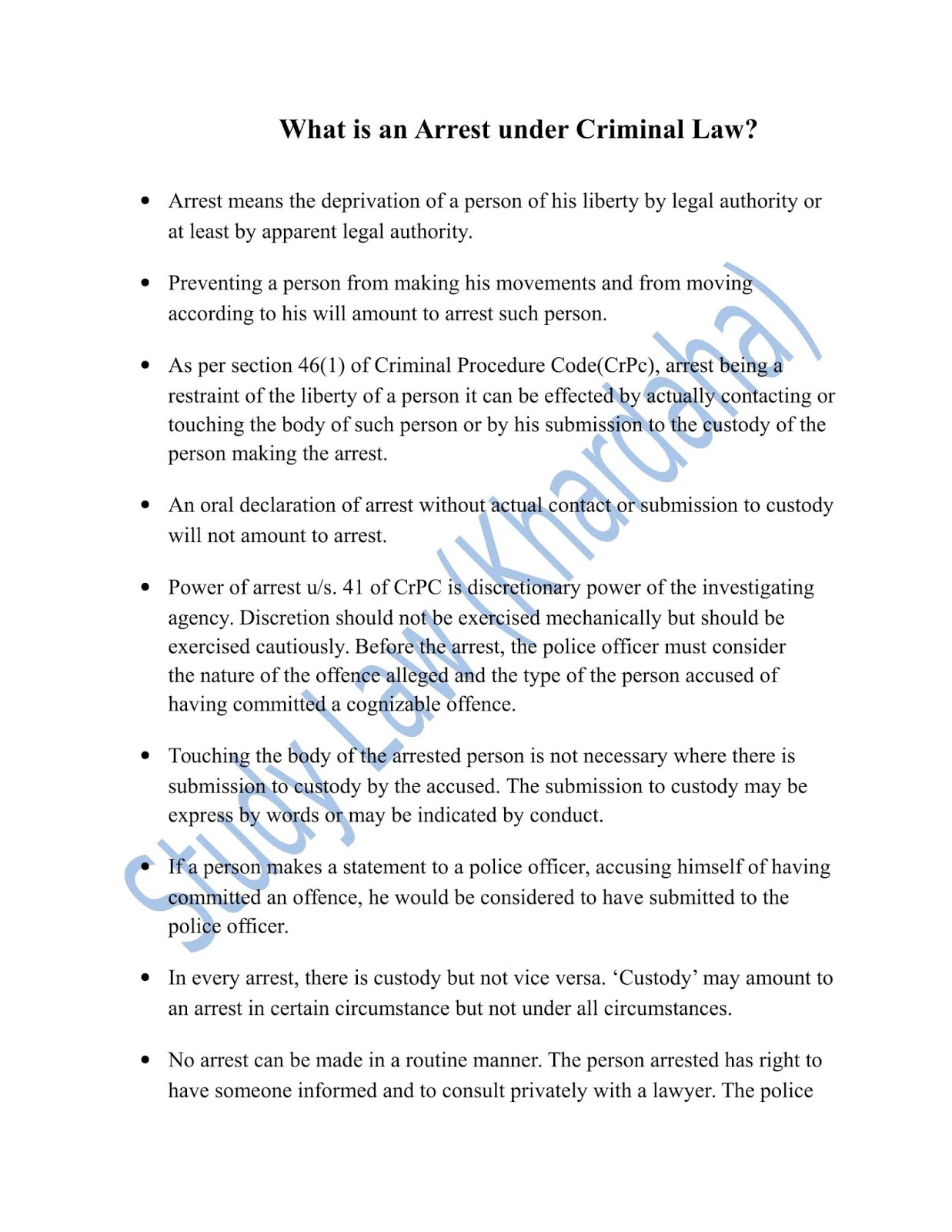
Arrest means the deprivation of a person of his liberty by legal authority or at least by apparent legal authority. Here it is discussed - what is arrest, how the arrests are made, what powers have been given to the police officer making an arrest, what rights the arrestee have, what procedure a police officer needs to follow for making an arrest, what procedure a police officer needs to follow to arrest a woman and what is handcuffing. 

List of 10 Landmark Judgments Passed by Supreme Court of India in 2017 - 2018

Image
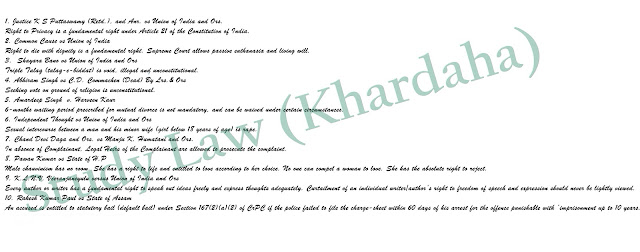
This is a list of 10 landmark judgments that were delivered by the apex court of India very recently. All these judgments are quite brave and progressive. 1. Justice K S Puttaswamy (Retd.), and Anr. vs Union of India and Ors. Right to Privacy is a fundamental right under Article 21 of the Constitution of India. 2. Common Cause vs Union of India Right to die with dignity is a fundamental right. Supreme Court allows passive euthanasia and living will. 3. Shayara Bano vs Union of India and Ors Triple Talaq (talaq-e-biddat) is void, illegal and unconstitutional. 4. Abhiram Singh vs C.D. Commachen (Dead) By Lrs.& Ors Seeking vote on ground of religion is unconstitutional. 5. Amardeep Singh v. Harveen Kaur 6-months waiting period prescribed for mutual divorce is not mandatory, and can be waived under certain circumstances. 6. Independent Thought vs Union of India and Ors Sexual intercourse between a man and his minor wife (girl below 18 years of age) is rape. 7. Chand Dev...