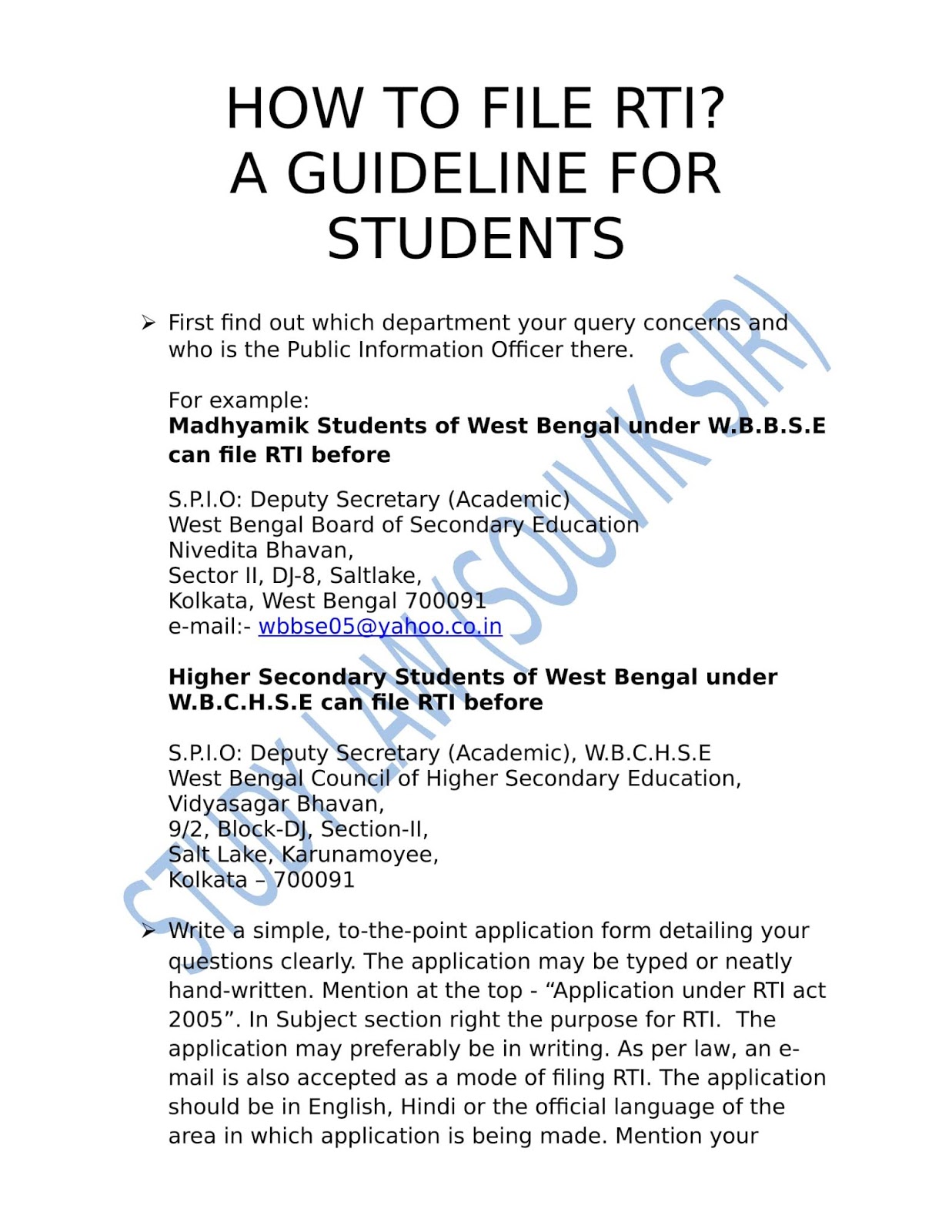
STUDENTS CAN FILE RTI TO GET COPIES OF THEIR ANSWER SHEETS: A GUIDELINE FOR STUDENTS ON HOW TO FILE RTI
In Kumar Shanu and Anr. Vs. YSK Seshu Kumar, Chairman, CBSE, Contempt Petition (Civil) No. 9837/2016 in Civil Appeal No. 6454/2011, the Supreme Court held -
"Answer-Sheet is an Information and therefore, examinees shall have the right to inspect their Answer-Sheets under RTI Act, 2005 and its Rules made thereunder which prescribes Rs 10/- as application fee for getting the information and Rs. 2 per page for the copies of such information."
In CBSE & Anr. Vs. Aditya Bandopadhyay & Ors. –Civil Appeal No. 6454/2011, the Supreme Court held -
i) “The examining bodies (Universities, Examination Boards, CBSC etc.) are neither security nor intelligence organisations and therefore the exemption under section 24 will not apply to them. The disclosure of information with reference to answer-books does not also involve infringement of any copyright and therefore section 9 will not apply. Resultantly, unless the examining bodies are able to demonstrate that the evaluated answer-books fall under any of the categories of exempted `information' enumerated in clauses (a) to (j) of sub-section (1) section 8, they will be bound to provide access to the information and any applicant can either inspect the document/record, take notes, extracts or obtain certified copies thereof.”
ii) “Section 22 of RTI Act provides that the provisions of the said Act will have effect, notwithstanding anything inconsistent therewith contained in any other law for the time being in force. Therefore the provisions of the RTI Act will prevail over the provisions of the bye-laws/rules of the examining bodies in regard to examinations. As a result, unless the examining body is able to demonstrate that the answer-books fall under the exempted category of information described in clause (e) of section 8(1) of RTI Act, the examining body will be bound to provide access to an examinee to inspect and take copies of his evaluated answer-books, even if such inspection or taking copies is barred under the rules/bye-laws of the examining body governing the examinations."
iii) “The term `fiduciary' refers to a person having a duty to act for the benefit of another, showing good faith and condour, where such other person reposes trust and special confidence in the person owing or discharging the duty. The term `fiduciary relationship' is used to describe a situation or transaction where one person (beneficiary) places complete confidence in another person (fiduciary) in regard to his affairs, business or transaction/s. The term also refers to a person who holds a thing in trust for another (beneficiary).”
“The examining body entrusts the answer-books to an examiner for evaluation and pays the examiner for his expert service. The work of evaluation and marking the answer-book is an assignment given by the examining body to the examiner which he discharges for a consideration. Sometimes, an examiner may assess answer-books, in the course of his employment, as a part of his duties without any specific or special remuneration. In other words the examining body is the `principal' and the examiner is the agent entrusted with the work, that is, evaluation of answer- books."
“Once the examiner has evaluated the answer books, he ceases to have any interest in the evaluation done by him. He does not have any copy-right or proprietary right, or confidentiality right in regard to the evaluation. Therefore it cannot be said that the examining body holds the evaluated answer books in a fiduciary relationship, qua the examiner.”
“We, therefore, hold that an examining body does not hold the evaluated answer-books in a fiduciary relationship. Not being information available to an examining body in its fiduciary relationship, the exemption under section 8(1)(e) is not available to the examining bodies with reference to evaluated answer-books. As no other exemption under section 8 is available in respect of evaluated answer books, the examining bodies will have to permit inspection sought by the examinees.”
iv) “The information as to the names or particulars of the examiners/co-ordinators/scrutinisers/head examiners are therefore exempted from disclosure under section 8(1)(g) of RTI Act, on the ground that if such information is disclosed, it may endanger their physical safety. Therefore, if the examinees are to be given access to evaluated answer- books either by permitting inspection or by granting certified copies, such access will have to be given only to that part of the answer-book which does not contain any information or signature of the examiners/co- ordinators/scrutinisers/head examiners, exempted from disclosure under section 8(1)(g) of RTI Act.”
“If the rules and regulations governing the functioning of the respective public authority require preservation of the information for only a limited period, the applicant for information will be entitled to such information only if he seeks the information when it is available with the public authority. For example, with reference to answer-books, if an examinee makes an application to CBSE for inspection or grant of certified copies beyond three months (or six months or such other period prescribed for preservation of the records in regard to other examining bodies) from the date of declaration of results, the application could be rejected on the ground that such information is not available.”
So first of all, you need to be real quick to apply under RTI Act 2005 to get your copies of evaluated answer books. Try to apply within three (months)from the date of declaration of results.
The procedures for filing RTI are as follows:
So first of all, you need to be real quick to apply under RTI Act 2005 to get your copies of evaluated answer books. Try to apply within three (months)from the date of declaration of results.
The procedures for filing RTI are as follows:



thanks for sharing information related to RTI.we also sharing information about to RTIFile RTI Online
ReplyDelete