SABARIMALA TEMPLE – CONFLICT BETWEEN CUSTOMS AND LAW?
 | |
|
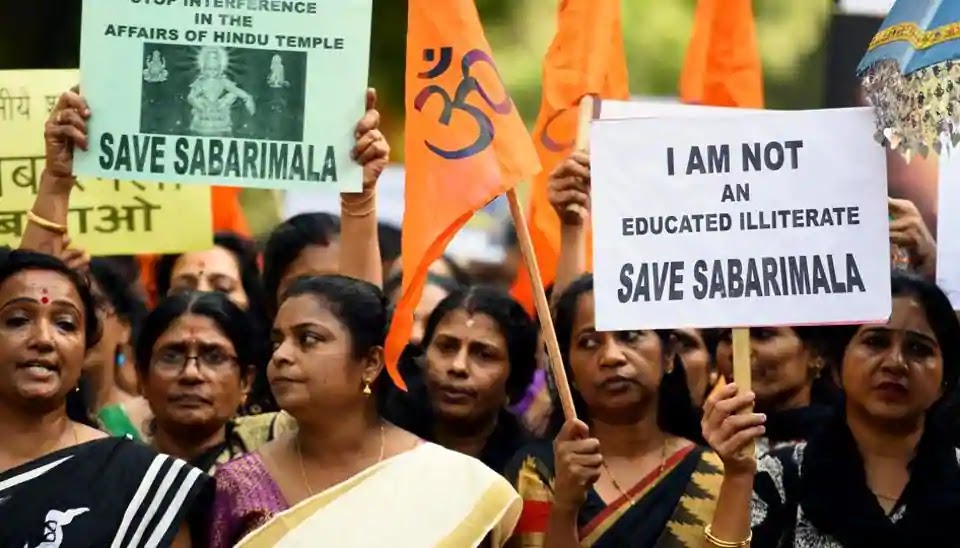
Sabarimala Sree Dharma Sastha Temple is a famous temple located in the Pathanamthitta district of Kerala. The temple is managed by the Travancore Devaswom Board along with other stakeholders Tantri (head priest) family, Pandalam Royal Family, Ayyappa Seva Sangam etc.
The shrine at Sabarimala is an ancient temple of Ayyappan. Lord Ayyappan is also known as Sasta and Dharmasasta. Lord Ayyappa is believed to be born out of the union of two male Gods Shiva and Mohini, where Mohini is Vishnu in a female form.
Lord Ayyappan is worshipped as a Naishtika Bramhachari. Naishtika Bramhachari means celibate for life. So the Devaswom Board that manages the temple, issued a notification that women belonging to the menstruating age are not permitted to enter the temple. That’ why women between 10 and 50 years of age are not allowed to enter into Sabarimala Temple.
On September 28, 2018, Indian Young Lawyers Association vs The State of Kerala, the Supreme Court ruled that restricting entry of women of menstruating age (between 10 and 50 years old) was unconstitutional. The Constitution bench in a 4-1 verdict said the notifications dated 21 October 1955 and 27 November 1956 issued by the Devaswom Board violated the right to equality and right to worship.
Sociological Aspect of the Judgment –
Beside the legal application, the Court has also showered lights on sociological aspect while delivering the judgment -
Chief Justice of India, Dipak Mishra mentioned significantly in the judgment –
“The irony that is nurtured by the society is to impose a rule, however unjustified, and proffer explanation or justification to substantiate the substratum of the said rule. Mankind, since time immemorial, has been searching for explanation or justification to substantiate a point of view that hurts humanity. The theoretical human values remain on paper.”
The court has also summed it down beautifully –
“The society has to undergo a perceptual shift from being the propagator of hegemonic patriarchal notions of demanding more exacting standards of purity and chastity solely from women to be the cultivator of equality where the woman is in no way considered frailer, lesser or inferior to man. The law and the society are bestowed with the Herculean task to act as levellers in this regard… "
The Court has significantly explained the relationship between Man and Creator -
“ Any relationship with the Creator is a transcendental one crossing all socially created artificial barriers and not a negotiated relationship bound by terms and conditions. Such a relationship and expression of devotion cannot be circumscribed by dogmatic notions of biological or physiological factors arising out of rigid socio-cultural attitudes which do not meet the constitutionally prescribed tests. Patriarchy in religion cannot be permitted to trump over the element of pure devotion borne out of faith and the freedom to practise and profess one‟s religion.”
Legal Aspect of the Judgment
The Court held that the devotees of Lord Ayyappa are just Hindus and do not constitute a separate religious denomination. For a religious denomination, there must be new methodology provided for a religion. Mere observance of certain practices, even though from a long time, does not make it a distinct religion on that account.
The Court also held that right guaranteed under Article 25(1) has nothing to do with gender or, for that matter, certain physiological factors specifically attributable to women.
The Court further held that the exclusionary practice being followed at the Sabrimala temple by virtue of Rule 3(b) of the 1965 Rules violates the right of Hindu women to freely practise their religion and exhibit their devotion towards Lord Ayyappa. This denial denudes them of their right to worship. The exclusionary practice is neither an essential nor an integral part of the religion.
Conclusion
From the above discussion, it can be concluded that there is no conflict between customs and law. The notification issued by the Board is itself an arbitrary one. In several temples where Lord Ayyappa is worshipped, this kind of exclusionary practice does not exist. That’s why this exclusionary practice is not a custom, rather an arbitrary decision of the temple authorities on devotees.
Comments
Post a Comment